
Netflix and Disney+ are seeing a steady increase in foreign-language content, with the strongest markets for programming in Japanese, French, Korean and Turkish, according to a new report from Ampere Analysis.
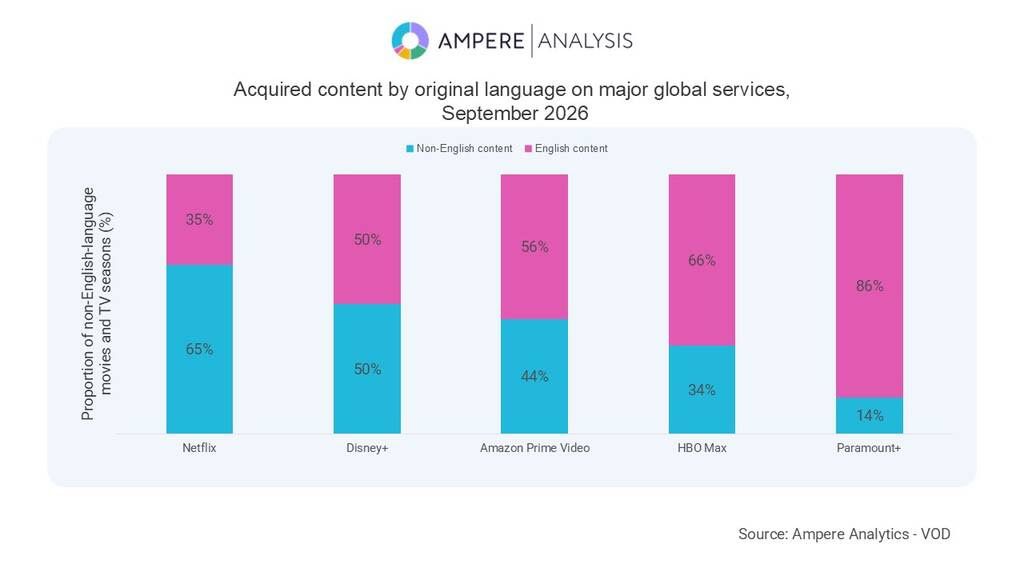
According to the researcher, non-English-language content accounts for a growing share of platform acquisitions. As of September, more than half of the content acquired by Netflix and Disney+ originated from non-English-speaking countries. Netflix leads in this regard, with 65% of its acquired content non-English, followed by Disney+ at 50%. Japan and South Korea were the leading source countries for Netflix’s non-English acquisitions, while Germany and Japan topped the list for Disney+.

Japanese, French, South Korean and Turkish content present key acquisition opportunities. These markets are identified by comparing the number of titles exported internationally with their overall popularity, with high popularity and relatively low export volumes indicating the greatest licensing potential. South Korean and Turkish content in particular offer promising opportunities for international licensing and distribution, as global demand remains strong while international availability is comparatively limited.
Japanese content has substantial scope for wider distribution, Ampere adds. Only 40% of Japanese VOD content is available internationally. Science fiction and fantasy lead its export genres, driven particularly by anime, which accounts for two-thirds of Japan’s 100 most internationally portable titles in 2026. While the U.S. and South Korea are established destinations, France and Germany combine relatively high popularity with limited imports.
South Korean content remains under-distributed despite its global appeal. Some 45% of titles are available only on domestic VOD services. Romance leads among the country’s most internationally portable titles, followed by science fiction and fantasy. The Middle East and Southeast Asia offer further licensing opportunities, particularly for romance.
Turkish content combines relatively high popularity with limited international availability. Just 30% is distributed internationally, with fewer than 1,000 titles exported. Romance accounts for 43% of Turkey’s 100 most internationally portable titles in 2026. The Middle East is its main export destination, but availability remains limited to around 600 Turkish films and TV seasons. The UAE, Saudi Arabia and Egypt are priority markets for further distribution.
French films offer opportunities in neighbouring European markets. France has a more-established international distribution footprint, with 76% of its on-demand content available overseas. Films perform particularly strongly on popularity. Germany and the US are key existing destinations, while Italy, Austria and Switzerland offer further potential.
Non-English content remains underexploited despite growing global demand, Tinging Li, research manager for Ampere, said.
“In recent years, Amazon Prime Video, HBO Max and Disney+ have increasingly expanded non-English-language title licensing in multiple markets. Japanese, South Korean, French and Turkish content present the top opportunities for international licensing, with strong audience appeal but still gaps in cross-border availability,Li said. “For content owners and platforms, buying this content can bridge the gap between audience demand and international distribution.”